Bid day is where estimates go to die. Not because the pricing was wrong, but because someone skipped a verification step. A missing addendum acknowledgment can make a sharp bid non-responsive. One missed subcontractor quote can leave a six-figure hole in your number. A bid form filled out wrong can get you thrown out before the numbers are even read.
Most contractors lose more bids to avoidable bid-day errors than to bad pricing. The checklist below is the one veteran estimators run before anything goes out the door. It takes about an hour on a typical bid, and it catches the mistakes that cost margins and awards.
The 15-Point Bid Day Checklist
Documents first: bid the right project
1. Every addendum received, logged, and acknowledged
Addenda override the original documents, and missing one is the single most common bid-day failure. Keep a master addenda log during the bidding window: addendum number, issue date, and what changed. On bid day, confirm your log matches the issuing office's record, verify each addendum is acknowledged on the bid form, and confirm your quantities reflect the latest revisions. Estimators at firms that handle public work routinely find bids disqualified over exactly this, because a bid that fails to acknowledge addenda can be ruled non-responsive regardless of price.
2. Drawing revisions match what you took off
Confirm the revision dates on your takeoff sheets match the current plan set. A mid-bid revision to a structural sheet that never made it into your takeoff can swing concrete or steel quantities by double digits. Scan the title blocks of every sheet you measured before you start the final review.
3. Re-read the Instructions to Bidders and Division 01
These sections carry the requirements that quietly kill bids: bid security amounts, insurance limits, pre-bid meeting attendance, submission format, and whether alternates or unit prices are mandatory or voluntary. Read them once at bid start and once again on bid day. Requirements you memorized on day one of a three-week bid window are the ones you misremember.
4. Every RFI resolved or carried as a written assumption
For every RFI you sent, confirm it was answered and that the answer is priced into the estimate. For every question that was never answered, do not bury it. Write the exact assumption into your proposal. A stated assumption can be priced as a change later; a hidden guess becomes your problem when the drawings finally clarify it.
5. Conflicting documents resolved by hierarchy
When drawings and specs disagree, the contract's order of precedence decides, usually in this order: addenda, supplementary conditions, general conditions, specifications, then drawings. If you priced from the first reference you found instead of checking the others, you may have priced the wrong scope. The conflicts you missed in week one are the ones that surface on bid day, when there is still time to submit one last RFI or at least carry a written assumption.
Numbers: trust but verify your own math
6. Takeoff spot-check for double-counts and missed scope
Re-verify the areas where errors hide: missed floors, double-counted sheets, wall-type groupings checked against the legend, rated assemblies, and every alternate shown on the drawings. Pull three or four line items and trace them from the plan through your software into the estimate. If the chain holds on all four, the takeoff is sound. If one breaks, the full review starts now.
7. Units of measure verified across the estimate
Square feet priced as linear feet, cubic yards as tons, eaches as pairs. Unit errors are silent because the math still foots perfectly. Scan every quantity line and confirm the unit matches the assembly it prices, especially on electrical, plumbing, and millwork scopes where units shift constantly.
8. Subcontractor and supplier quotes are current and in scope
Confirm every sub quote is dated within the bidding window, matches the current plan revision, and covers every line item you assumed it covers. A quote from two weeks ago may predate the addendum that added a second chiller. Industry reviews of common bid mistakes flag outdated material pricing as a repeat offender, and sub quotes that quietly excluded scope are how GCs end up holding a trade they never priced.
9. Level your sub quotes against your own takeoff
Do not carry the low sub number blind. Compare the two or three quotes per trade against each other and against your own quantity takeoff. A quote that is 20 percent under the others is not a gift; it is a scope gap, a missed addendum, or a desperate sub. Leveling takes an hour. The alternative is discovering the gap after award, when the sub walks away and the replacement costs what everyone else bid the first time.
10. Alternates, allowances, and unit prices in the required format
Check the bid form for every required line: base bid, each alternate, each unit price, each allowance. Ambiguous qualification on a required line can get a bid thrown out. If the owner asked for alternates in a specific format, give them that exact format. A perfectly priced alternate in the wrong format is worth nothing.
11. Labor productivity and schedule duration sanity-checked
Look at your labor hours and ask whether a real crew can hit them. Estimators routinely overestimate productivity without accounting for weather delays, difficult site access, or local union rules, and the estimate looks fine until week three of the job. Confirm the schedule duration behind your general conditions still matches the contract dates. If the owner extended the completion date by addendum and you priced GCs off the old schedule, you just donated a month of supervision.

Money: the lines that quietly eat margin
12. Overhead, bond, insurance, and taxes all present
Confirm home-office overhead is allocated, bid bond and performance bond costs are in, insurance meets the spec minimums, and sales tax treatment matches the jurisdiction. Unclear overhead allocation shrinks net margins unexpectedly, and a bond cost missed on bid day becomes a cost you pay out of profit at closeout.
13. Markup set deliberately, not by habit
Your standard 10 percent markup is not automatically right for this bid. Ask: how many bidders, how much risk in the documents, how clean is the scope, how busy is the shop? Review the overhead and markup lines explicitly and record why you chose them. Margin set by habit is how contractors leave money on easy bids and get greedy on risky ones.
14. The total cross-footed by someone other than the estimator
This is the cheapest insurance in construction. Have a second person, someone who did not build the estimate, run the arithmetic: subtotals, extensions, unit price times quantity, the grand total. Transcription mistakes, like a misplaced decimal or a wrong number carried from a worksheet, are exactly the kind of clerical error that courts will usually let you correct after opening, but only if you catch the pattern. A dropped floor or a decimal that slipped one place turns a winning bid into a losing job.
Submission: get it in the room on time
15. The bid form is complete, signed, and submitted early
Fill the owner's bid form verbatim. Modifications to the form are routinely grounds for disqualification on public work. Check every required element: signatures, bid security, addenda acknowledgment boxes, alternates, attachments, the exact base bid number. Then submit early. Public bid openings are absolute; one minute late is rejected, and electronic portals fail more often than anyone admits. Upload or deliver at least 30 to 60 minutes early, confirm receipt with a timestamp, and save a copy of exactly what was sent.
How a Bid-Day Catch Pays for Itself
Here is a clearly labeled hypothetical that shows why check number 14 matters. A subcontractor prices a commercial drywall package. The estimator carries $48,250 in material from the supplier quote, enters it in the workbook, and types $42,850 into the bid form by transposition. The bid total comes to $412,600 instead of the real $418,000.
The bid is the low bid by $3,000 and wins. The transposition is discovered at contract signing. That $5,400 never existed as margin; it comes straight out of profit, and on a $400,000 package that is more than the estimator's entire markup. A ten-minute cross-foot by the project manager would have caught it. In many jurisdictions, an obvious clerical mistake like a misplaced decimal is the one kind of bid error courts will let you correct or withdraw from, but judgment errors, like underestimating labor or material costs, almost never qualify. The distinction matters: math errors get relief, pricing judgment does not. Catch the math yourself and you never need the court's help.
What Each Bid-Day Error Actually Costs
| Error | How it surfaces | Typical cost |
|---|---|---|
| Missed addendum acknowledgment | Bid ruled non-responsive | The entire bid: disqualified |
| Unpriced scope from a sub quote | Sub walks or bills extra after award | Replacement sub at market price, often 10 to 20 percent over the bid number |
| Unit of measure error | Footed perfectly, caught at billing | Material overruns of 50 to 100 percent on the affected line |
| Unacknowledged bid form changes | Modified form rejected on public work | The entire bid: disqualified |
| Late submission | Portal glitch or traffic | The entire bid: rejected |
| Transposition or decimal error | Caught after award | Margin erosion equal to the error, usually unrecoverable |
The 30-Minute Bid-Day Sequence
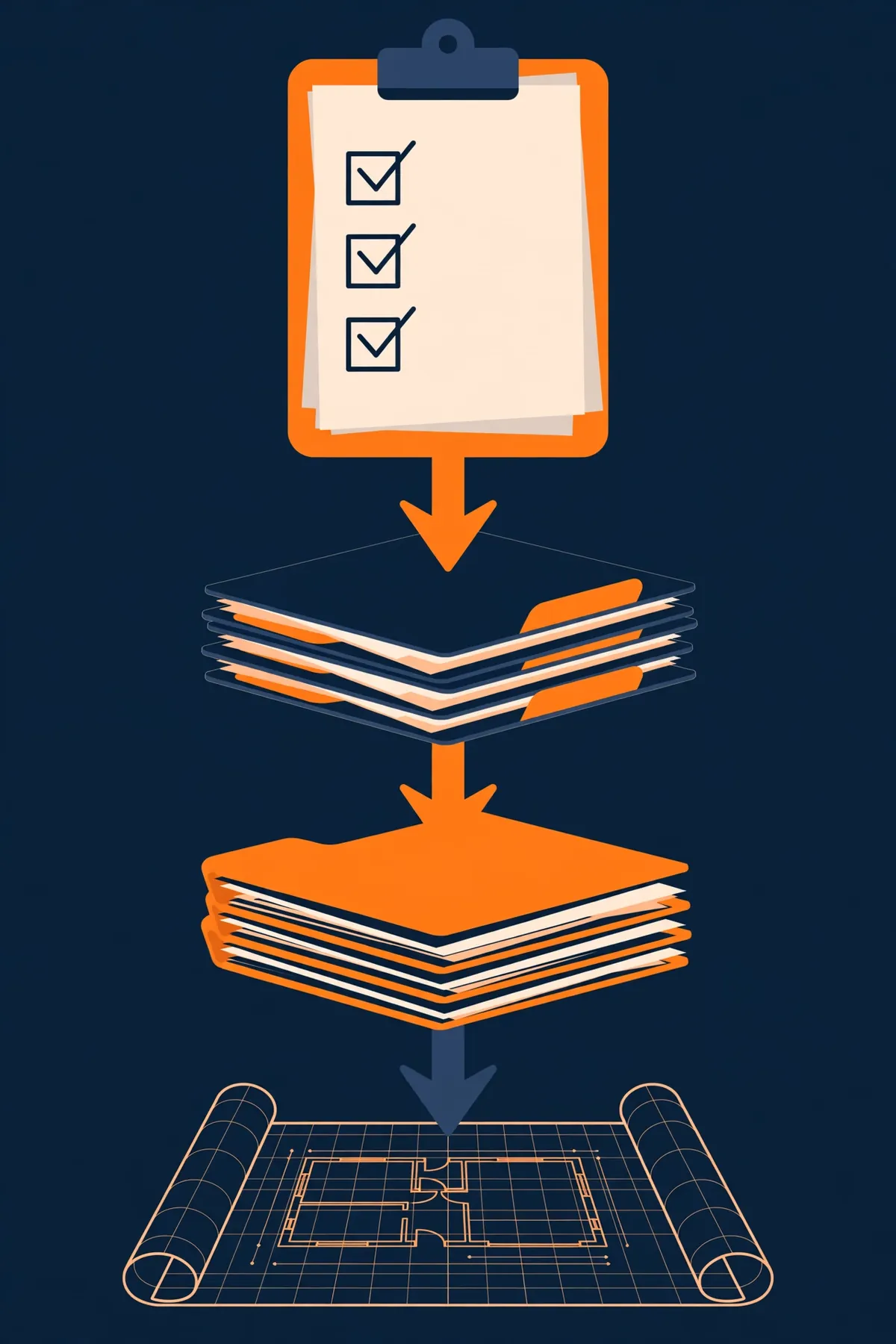
Checklists fail when they get run at 3:50 PM for a 4:00 PM bid. Run them in this order, and start 60 to 90 minutes before the deadline.
- First 10 minutes: documents. Addendum log matches the plan room, RFI log current, bid form requirements re-read. If anything is missing, you still have time to find it.
- Next 15 minutes: numbers. Spot-check the takeoff chain, verify units, confirm sub quotes are current and leveled, check alternates and unit prices against the form.
- Next 10 minutes: money. Overhead, bond, insurance, taxes in; markup reviewed; total cross-footed by a second person.
- Final 5 minutes: submit. Form filled verbatim, signed, security attached, addenda boxes checked. Submit, confirm receipt, save your copy. Then step away from the computer.
The discipline is the point. Every estimator who has run this checklist has caught something at least once: an unpriced alternate, a sub quote from the old drawing revision, a bid bond in the wrong amount. The hour you spend is cheaper than the margin you would have paid.
Frequently Asked Questions
What happens if you miss an addendum on bid day?
On most public work, failure to acknowledge addenda that affect price or scope makes your bid non-responsive, and the awarding authority must reject it. The safest practice is to maintain an addenda log from day one of the bid and confirm it against the issuing office's record before you submit. Some jurisdictions allow waiving a missed acknowledgment when the addendum is minor and changes nothing about price or scope, but never count on that discretion.
Can you correct a bid after it has been submitted?
Sometimes, but the bar is high. Courts generally allow relief only for clerical mistakes that are obvious on the face of the bid, like a misplaced decimal or a transcription error, and even then you must prove the mistake was made without negligence and that relief would not prejudice the other party. Errors of judgment, underestimating labor costs, misreading site conditions, failing to get a firm supplier quote, are almost never correctable. The practical lesson: catch math errors in your own review, because the legal remedy is unreliable and expensive.
Should the estimator review their own bid on bid day?
The estimator should review it, but not alone. A second pair of eyes catches what familiarity hides: the transposed digit you have read past four times, the missing floor you took off so often you stopped seeing it. Assign the final cross-foot to someone who did not build the estimate.
Make Your Next Bid Day Boring
Every crisis on this checklist has the same cause: verification that got skipped because the estimate felt finished. Run the fifteen checks, submit early, and save a copy of what went out. That is what a professional bid looks like on bid day: unremarkable, complete, and defendable.
If your shop does not have the bench to give every bid this kind of review, that is exactly what an outside estimating team provides. Our bid estimating services include a full bid-day review as standard: addendum verification, sub quote leveling, a second-eyes cross-foot, and a final submission checklist. See how we price it on our pricing page, then send your plans for a project-specific bid estimate and let your next bid day be the boring kind.