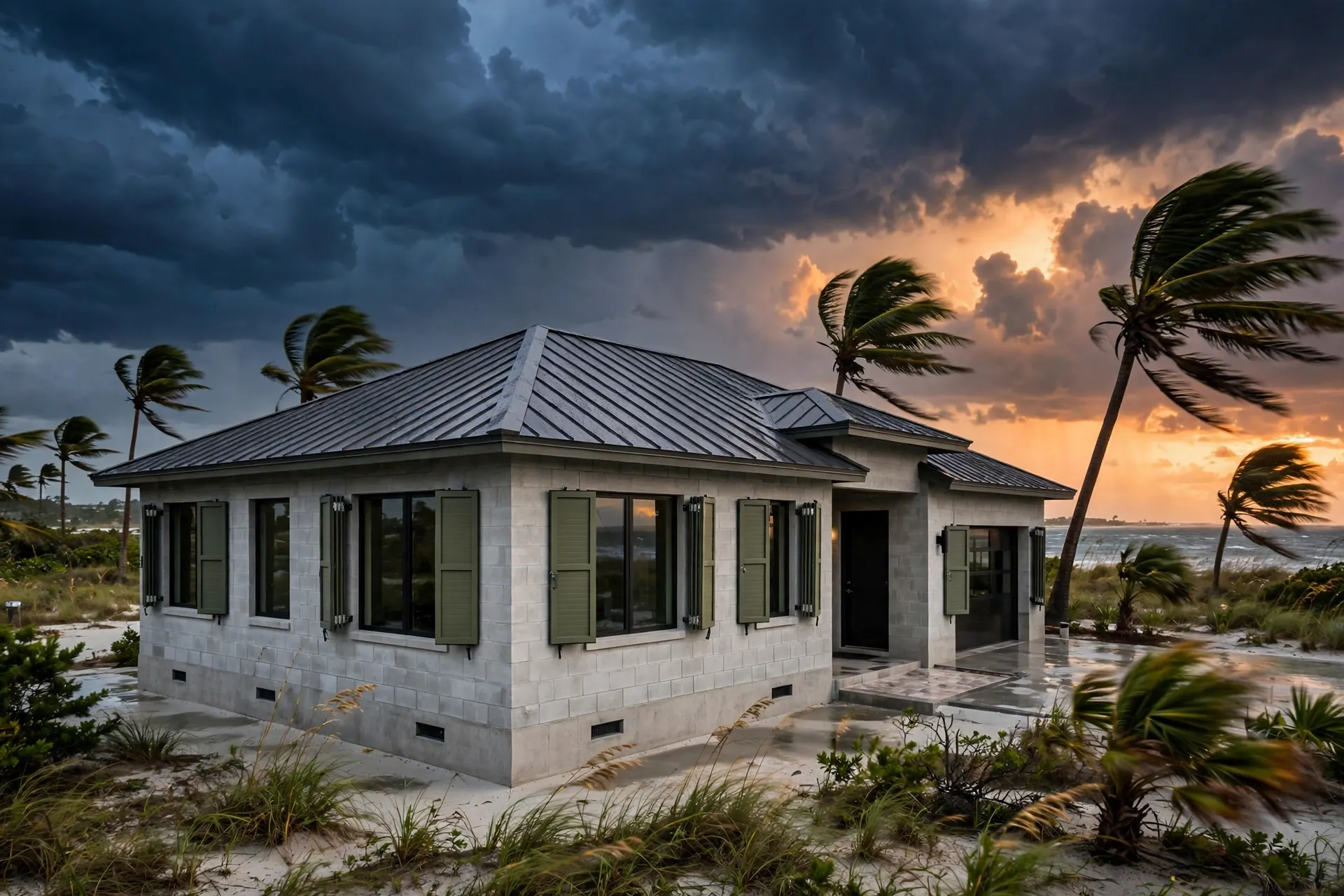
Bidding a house in Orlando and bidding the same floor plan in Miami are two different trades wearing the same name. In most of Florida you are estimating a building. In Miami-Dade and Broward counties you are estimating a building plus a parallel scope: hurricane hardening the code forces into every assembly, every opening, and every connection. Miss that second scope and your bid is not competitive. It is fiction.
The reason is the High-Velocity Hurricane Zone, the HVHZ. It is the strictest wind and product-approval regime in the United States, and it changes what you measure, what you price, and what paperwork you attach to the permit. This guide covers the HVHZ rules that move money and the line items contractors most often underprice, written for the code in effect now: the Florida Building Code 8th Edition (2023).
What the High-Velocity Hurricane Zone Actually Is
The HVHZ is a statutory designation covering exactly two counties: Miami-Dade and Broward. It dates to the 1994 South Florida Building Code, written after Hurricane Andrew exposed the old patchwork of local codes, and every Florida Building Code edition since has kept it as a special district with its own wind-load chapter and product-approval rules.
Contractors get this wrong in one specific way: they assume every coastal county in Florida is HVHZ. It is not. Palm Beach, Monroe, Collier, Lee, and Pinellas have high design wind speeds and wind-borne debris requirements, but they are not statutory HVHZ counties. That distinction decides which product approvals your submittal needs, and pricing Palm Beach work with Miami-Dade assumptions (or the reverse) is one of the fastest ways to lose a bid or a margin.
The current code is the Florida Building Code, 8th Edition (2023), which took effect December 31, 2023. It adopted ASCE 7-22 for wind loads, with updated wind speed maps and revised exposure provisions. The Florida Building Commission's workplan schedules the 9th Edition (2026) to take effect December 31, 2026. If you are reading this near that date, confirm which edition your AHJ is enforcing before you price anything, because the edition in force on the permit date governs the submittal.
The Wind Numbers That Drive Your Takeoff
Everything in the HVHZ starts with the basic wind speed on the code's wind maps. These are ultimate (3-second gust) speeds from ASCE 7-22, and they vary by Risk Category. The code's HVHZ tables put them here:
| Risk Category | Miami-Dade | Broward |
|---|---|---|
| I (low risk to life, e.g., storage) | 165 mph | 156 mph |
| II (standard homes, offices) | 175 mph | 170 mph |
| III (schools, assembly) | 185 mph | 180 mph |
Risk Category II covers nearly all residential and ordinary commercial work, so 175 mph in Miami-Dade and 170 mph in Broward are the numbers estimators memorize. Do not bid off the county headline, though. Read the actual value for the project address from the ASCE 7-22 maps: a coastal site and an inland site in the same county do not always share a contour, and the design pressure on every window and door in your takeoff follows from that number.
One more zone matters beyond the two HVHZ counties: the wind-borne debris region. It covers any area at 140 mph or higher, plus areas at 130 to 139 mph within one mile of the coastal mean high-water line, and the entire HVHZ sits inside it automatically. Estimating anywhere in the debris region means impact-rated glazing or approved protection on the openings. That single rule has ended more "cheap window package" bids than any other line in the code.
Product Approval: The NOA, the FL Number, and Why Your Bid Depends on Them
In the HVHZ, you cannot install a window, door, shutter, or roof assembly on the strength of a manufacturer's brochure. Every exterior product must prove hurricane performance through testing and carry an approval the building department will accept at permit. Two systems matter, and knowing which governs your site is an estimating task:
- Miami-Dade Notice of Acceptance (NOA). The county's own approval, issued after testing under the Miami-Dade protocols: TAS 201 (large missile impact, the 9-pound 2x4 test), TAS 202 (cyclic wind pressure), and TAS 203 (water resistance after impact). In the HVHZ, every envelope and roofing product needs a current NOA or equivalent Broward acceptance.
- Florida Product Approval (FL number). The statewide approval issued through the Florida Building Commission's online system. Outside the HVHZ, this is the minimum certification. A state approval whose limitations of use include the HVHZ is accepted inside it as well. A Miami-Dade local approval, by contrast, is valid in Miami-Dade.
Three practical rules for estimators and the subs you price with. First, verify the NOA is current and lists your exact model: expired approvals and wrong-model substitutions are a standard cause of permit denial. Search the county's product control database through Miami-Dade County's building department page, and search state approvals by FL number, manufacturer, or category through the Florida Building Commission's Product Approval program.
Second, Florida approvals do not die on a fixed birthday. Under state statute, an approval stays valid until the code requirements behind it change, the product is modified, or it is revoked, but manufacturers must affirm compliance each code cycle. A product approved under the 7th Edition may not carry into the 8th, so check the edition on the approval, not just its existence. Third, the permit submittal names the approvals: applications routinely require the FL or NOA number for the roofing and envelope systems, so price the hours to assemble that package.
Local amendments are the standing warning. The Florida Building Code is the statewide minimum, but Miami-Dade County, Broward County, and individual municipalities can and do layer stricter requirements on top. Confirm the local amendments with the authority having jurisdiction before you lock a price.
Seven Line Items That Move an HVHZ Estimate
This is where the HVHZ stops being a code lecture and becomes quantities and dollars. Each of these is a scope item that exists (or costs materially more) because of the zone. If your takeoff template was built for Central Florida, every one of these needs a dedicated line.
| Line item | What the HVHZ changes | Takeoff note |
|---|---|---|
| Impact-rated glazing | Windows and doors need impact ratings or approved shutters; HVHZ products carry a substantial premium over standard-zone equivalents (industry estimates put it at 30 to 60 percent) | Count every opening; verify the DP rating on the NOA meets the site's calculated pressure |
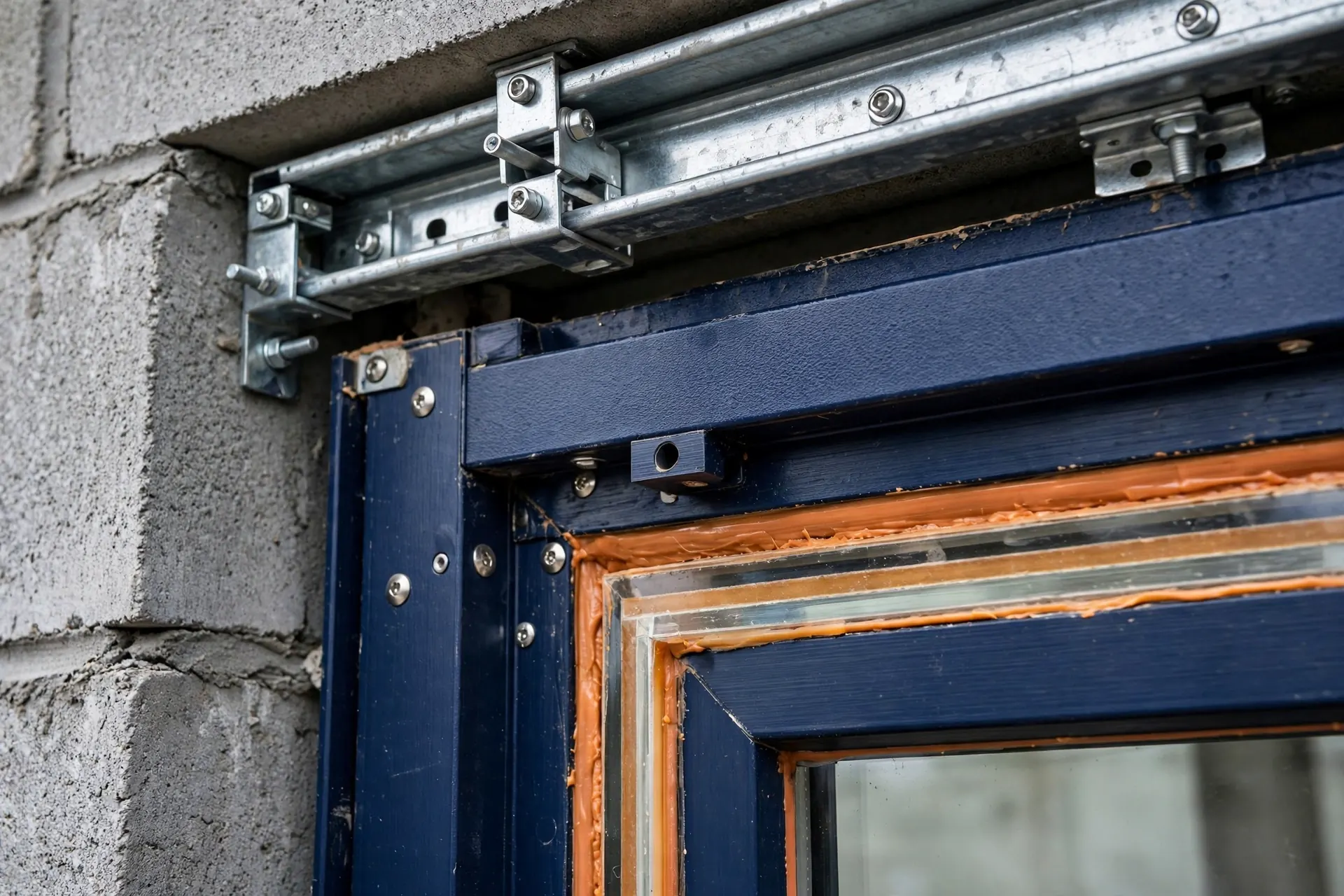
| Shutters vs. impact glass | Shutters are the cheaper material path but add hardware, tracks, motors or manual deployment labor | Price the full system: panels, tracks, fasteners, and installation, not just the panel |
| Sealed roof deck | Secondary water barrier under the roof covering is standard practice in high-wind Florida work | Measure the full deck area; self-adhered membrane is a separate material and labor line from the covering |
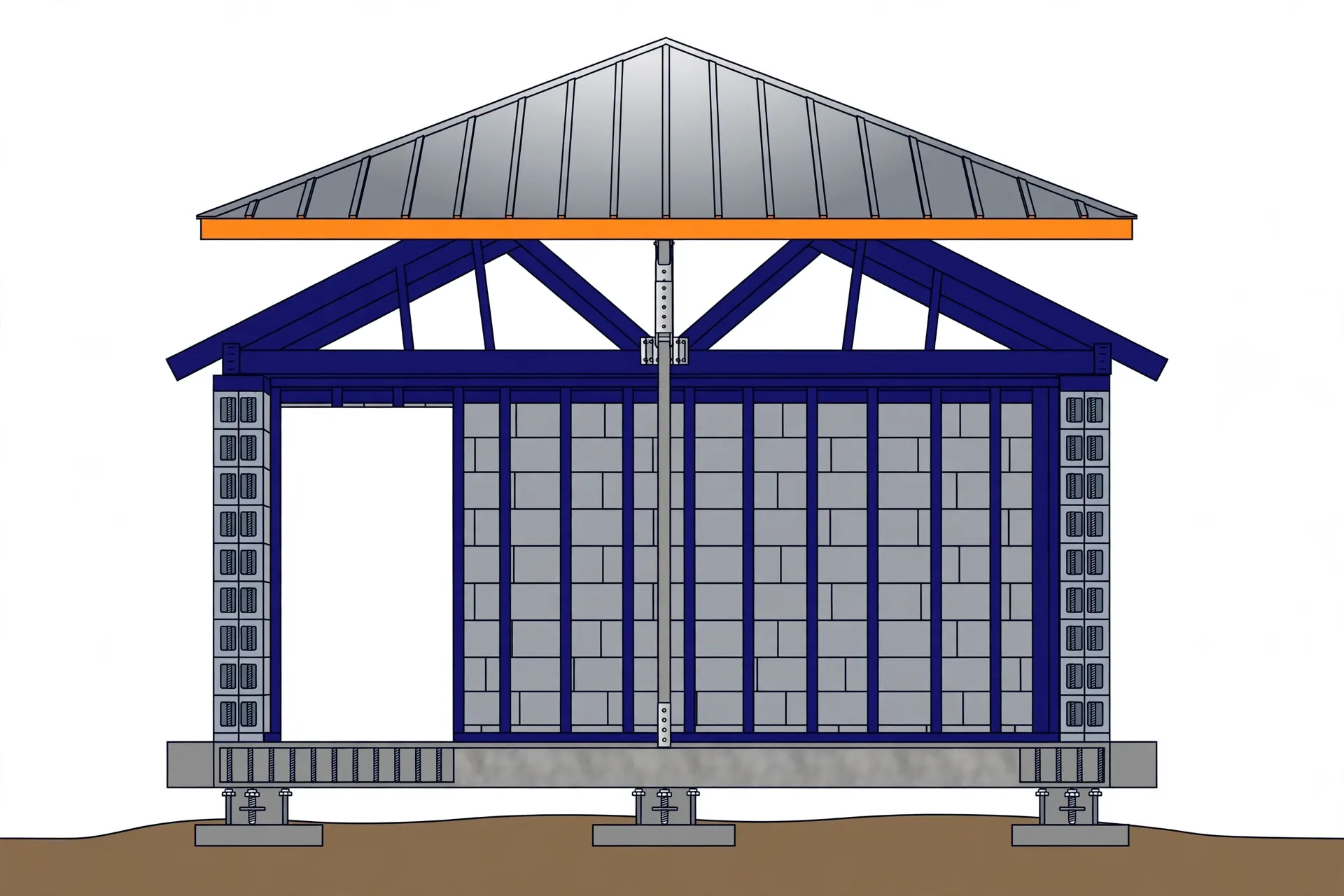
| Continuous load path | Roof-to-wall-to-foundation connections (straps, holdowns, anchor bolts) sized for HVHZ uplift | Connection count, not square footage, drives this cost; pull it from the structural sheets |
| Roofing system | HVHZ-rated assemblies with specified fastening patterns and NOA documentation | Mechanical fastening quantities rise; verify the assembly's NOA covers the specified slope and deck |
| Garage doors | Must be impact-rated and reinforced; a standard door is a failed inspection | One line, but a big one; price the rated door, not the catalog door |
| Special inspections | Third-party inspections of envelope and roofing installations, phase by phase | Cost plus schedule: inspections gate the work, so carry the calendar impact too |
Two of these break the most bids. First, the continuous load path: estimators who price connections as a square-foot allowance are guessing. The structural sheets specify every strap, holdown, and anchor bolt, and HVHZ uplift forces push those counts well past non-HVHZ details. Second, the glazing package: a 28-opening schedule at standard pricing is a different project than the same schedule with impact-rated units. One blended "windows" allowance is not an estimate.
What It Costs: A Hypothetical 2,500 Sq Ft Home
Hypothetical scenario, not a real project. The numbers below are planning ranges built to show how the HVHZ line items stack up, using the methodology at the end of this article. Take a 2,500 square foot single-family home with a 3,400 square foot roof, and price the identical plan in two places: Orlando (non-HVHZ) and Miami-Dade (HVHZ).
| HVHZ-driven line item | Approximate added cost vs. Orlando baseline |
|---|---|
| Impact window and door package upgrade (28 openings) | $16,500 |
| Sealed roof deck (secondary water barrier) | $4,800 |
| Continuous load path hardware and labor | $6,200 |
| Impact-rated garage door | $2,400 |
| HVHZ-rated roofing system upgrade | $5,500 |
| Special inspections (envelope and roof) | $3,200 |
| Permit and NOA documentation time | $1,600 |
| Total HVHZ premium | $40,200 |
Against an Orlando baseline hard cost near $650,000 for this plan, the HVHZ premium lands around $40,200, or about 6 percent. That runs above the published figures for voluntary above-code work: IBHS puts a FORTIFIED Gold new build near 3 percent over conventional construction, and a University of Alabama study of 40,000-plus homes found 0.5 to 3 percent for new construction and 6 to 16 percent for retrofits. The HVHZ premium runs higher because the zone mandates the hardening and layers NOA-grade products, special inspections, and documentation on top.
The point of the exercise is not the 6 percent. It is the shape of the cost: seven distinct lines, each traceable to a code requirement, each with its own quantity basis. An estimator who prices "hurricane stuff" as one 5 percent contingency line cannot defend the number in a bid review. The line-by-line estimator can.
The HVHZ Bid-Review Checklist
Run this before any South Florida number leaves your desk:
- Zone confirmed. Is the site actually in Miami-Dade or Broward? If not, which wind-borne debris region rules apply to it?
- Wind speed read from the map. Site-specific ASCE 7-22 value for the correct Risk Category, not a county average from memory.
- Glazing schedule rated. Every opening on the window and door schedule carries an impact rating or an approved shutter, with the NOA or FL approval number noted.
- NOAs current. Each specified product's approval is active, lists the exact model, and was issued or affirmed under the edition in force.
- Load path counted. Straps, holdowns, and anchor bolts pulled from the structural sheets as quantities, not an allowance.
- Roof assembly documented. The roofing system has an HVHZ-acceptable approval covering the specified deck and slope, and the sealed deck is a separate line.
- Inspections and paperwork priced. Special inspections and permit documentation carry both cost and calendar days.
Permit and Inspection Realities That Hit Your Schedule
Cost is only half the HVHZ story. The other half is time. South Florida permit review is thorough because the submittal is heavy: product approvals for the envelope and roofing, structural load-path details, and NOA documentation all get examined. Budget review cycles, not just a single submittal, and remember the edition in force on the permit date governs, so a project that slips across a code cycle can need re-documentation.
Inspections gate the work. HVHZ envelope and roofing installations face phased inspections verifying labels, anchorage, and details, and third-party special inspections are a normal part of the program. The 8th Edition era also brought mandatory milestone inspections for condominium and cooperative buildings three stories and taller, which affects renovation-scope estimating on older coastal buildings. When you estimate a re-roof or condo retrofit in South Florida, the inspection scope is part of the price.
One licensing note for contractors new to the market: Florida requires state-certified or locally registered contractors, and Miami-Dade runs its own contractor qualification process. Pricing with an unqualified crew's production rates is pricing a job that cannot legally be built that way.
How These Cost Ranges Were Built
Every figure in this guide is a planning range, not a quote. Here is the methodology so you can judge the numbers the way an estimator would.
| Assumption | What this guide uses |
|---|---|
| Pricing source | IBHS FORTIFIED cost data via industry press, the University of Alabama risk-research study of 40,000-plus homes, and published industry estimates for HVHZ product premiums. No RSMeans figures are quoted because current RSMeans datasets were not available during preparation. |
| Labor assumptions | Florida licensed-contractor crews at South Florida market rates, with production rates for impact-product installation and secondary-barrier application. |
| Location adjustment | Miami-Dade County HVHZ versus Orlando/Central Florida non-HVHZ baseline. Broward runs close to Miami-Dade; adjust down slightly for non-HVHZ high-wind counties. |
| Project size | 2,500 square foot single-family home, 3,400 square foot roof, 28 openings. Commercial and multifamily projects scale differently; connection counts and inspection scope grow faster than floor area. |
| Union vs non-union | Non-union residential baseline. Union commercial work in South Florida will run higher on the labor lines. |
| Overhead in the figures | Line items are direct cost deltas. General contractor overhead and profit apply on top, as does sales tax on materials where applicable. |
| Date reviewed | October 2026, under the Florida Building Code 8th Edition (2023). Re-check against the 9th Edition once it takes effect. |
Treat these as planning ranges; the closing section below covers project-specific numbers.
Frequently Asked Questions
Is my project in the HVHZ if it is near Miami but not in Miami-Dade or Broward?
No. The HVHZ covers only Miami-Dade and Broward counties in full. Nearby coastal areas can still fall in the wind-borne debris region (140 mph or higher, or 130 to 139 mph within a mile of the coast), which triggers impact-glazing rules, but the HVHZ product-approval regime itself does not apply.
Can I use a Florida Product Approval instead of a Miami-Dade NOA in the HVHZ?
A state approval whose limitations of use include the HVHZ is accepted there. But you cannot substitute a generic statewide approval for HVHZ use, and a Miami-Dade local approval is valid only in Miami-Dade. Read the limitations of use on the approval itself.
How do I check that a product's NOA is current?
Search the county's product control database through the Miami-Dade building department site and confirm the approval is active and lists your exact model number. Do it during estimating, not after the permit is filed.
Which code edition applies to my project?
The Florida Building Code 8th Edition (2023) is in force now, effective December 31, 2023. The 9th Edition is scheduled for December 31, 2026. The edition enforced is generally the one in effect when the permit is issued, so confirm with the local building department if your schedule crosses the transition.
Send Your Plans for a Florida Project-Specific Construction Estimate
HVHZ estimating rewards the estimator who reads the wind map, counts the connections, and verifies every approval before the bid goes out, and it punishes the one who prices South Florida like the rest of the state. If you are bidding in Miami-Dade, Broward, or Florida's other high-wind counties, our construction estimating services build the number line by line: quantities traced to your plans, HVHZ-rated products checked against current approvals, and a bid-ready workbook your team can defend. See how estimating fees work and national cost-to-build figures for context, then send your plans through our pricing page for a project-specific quote. Florida contractors can also review our Florida construction estimating services coverage.